
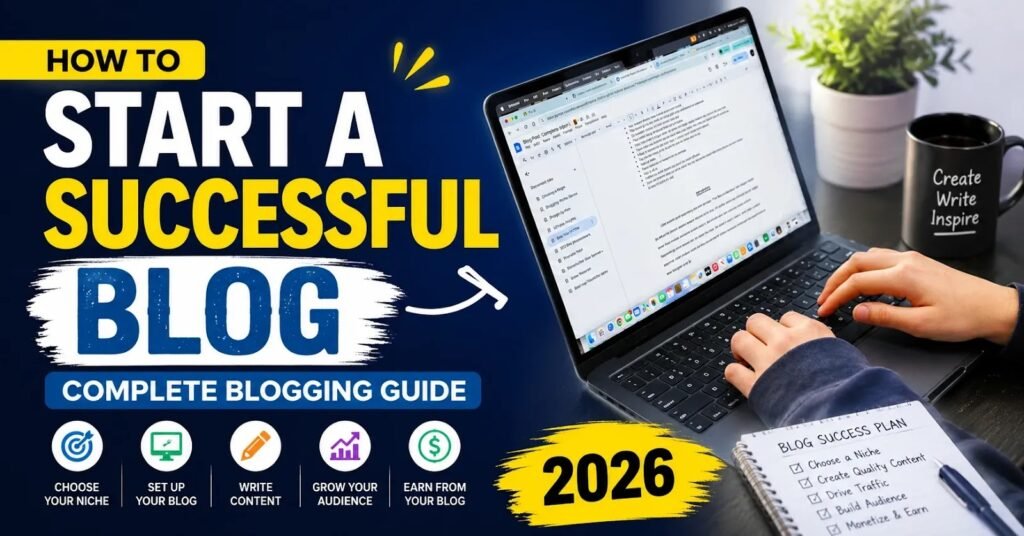
Your complete blogging guide for 2026. Learn how to start, grow, and monetize a blog step by step—perfect for Indian beginners with no technical skills.
.webp "How_to_Start_a_Successful_Blog_Complete_Blogging_Guide_(2026)")
In 2019, a 23-year-old engineering graduate from Raipur couldn’t find a job in his field. Rather than sending more desperate applications into the void, he started writing about what he knew—budget travel across Chhattisgarh and central India, the kind of trip planning information he’d wished existed when he was a broke college student exploring his home state.
Three years later, that blog was generating ₹1,80,000 per month from affiliate links, hotel partnerships, and display advertising. He hadn’t touched his engineering degree.
I’m not sharing this to suggest you’ll achieve the exact same results. Every blogger’s journey is different—growth takes time, outcomes vary, and success comes from consistent effort and learning. My goal is simply to show that blogging in 2026 is still a real and worthwhile opportunity for those who are willing to stay committed. a dead medium. For Indian creators with specific knowledge, consistent publishing habits, and the patience to build something real, it remains one of the most accessible paths to meaningful online income.
This complete blogging guide covers every step of the journey—from choosing the right blogging platform and setting up your website to creating your first blog post, growing your audience, and turning your blog into a source of income.
Step 1: Choose Your Niche (The Most Important Decision You’ll Make)
Before you register a domain or pick a platform, you need to answer one question: what will your blog be about?
Many beginners make the mistake of choosing a broad niche, thinking they can write about topics like lifestyle, fitness, or general health. While this may seem like a good idea, broad niches are highly competitive and often require years of consistent content creation and strong domain authority to rank well in search results. Focusing on a specific niche helps you target the right audience, build topical authority faster, and achieve better growth in less time.
How to choose a profitable niche:
Sit at the intersection of three things: what you genuinely know, what you’re genuinely interested in (because you’ll be writing about it for years), and what people actually search for.
Particularly promising niches for Indian bloggers in 2026:
Personal finance with India-specific context (SIP investing, tax saving under Indian tax laws, credit card optimization for Indian cards). Health and wellness tailored to Indian diets and lifestyle contexts. Career guidance for specific Indian industries or exam preparation. Regional food and travel content. Parenting with Indian cultural context. Small business and startup guidance.
The niche selection test: Google your potential niche. Are there other blogs covering it? Good—that means there’s audience demand. Are they all massive, well-funded publications? Drill narrower until you find a more specific angle where you can genuinely differentiate.
Want to learn more? Read our article on How to Write SEO-Friendly Articles.
Step 2: Pick the Right Blogging Platform
What Is the Best Blogging Platform for Beginners in 2026? The honest answer depends on your goals, budget, and technical comfort.
| Platform | Best For | Cost | Control |
|---|---|---|---|
| WordPress.org | Serious long-term bloggers | ₹2,500-6,000/year (hosting+domain) | Complete |
| WordPress.com | Beginners wanting simplicity | Free (limited) to ₹800/month | Moderate |
| Blogger | Completely free, basic setup | Free | Limited |
| Medium | Writers wanting built-in audience | Free | Minimal |
| Ghost | Paid newsletters and subscriptions | $9/month+ | Good |
| Substack | Newsletter-centric content | Free (revenue share) | Moderate |
| Wix | Visual, design-forward blogs | Free (limited) to ₹600/month | Moderate |
My honest recommendation for most Indian beginners: WordPress.org self-hosted on affordable Indian hosting (Hostinger India offers plans from ₹69-99/month) provides the most flexibility, the best SEO capabilities, and the smoothest upgrade path as your blog grows. The upfront cost is minimal—your domain (₹700-1,000/year) plus basic hosting—and it eliminates limitations that will frustrate you later if you choose a free platform.
If you want zero cost to start: Blogger.com is genuinely functional and allows Google AdSense monetization. Use it to test your commitment for 2-3 months before investing in self-hosted WordPress.
Step 3: Set Up Your Blog
How do I start a blog step by step with no technical skills?
For WordPress.org (which I’m recommending), the process is more straightforward than the “technical” label implies:
- Purchase a domain name (yourname.com or yournicheterm.com) from providers like Namecheap or GoDaddy India
- Buy hosting from Hostinger India, Bluehost, or BigRock
- Install WordPress with one click through your hosting control panel (every major host has this option)
- Choose a free theme—Astra, GeneratePress, and Neve are all excellent free WordPress themes
- Install essential plugins: Rank Math (SEO), Akismet (spam protection), WPForms (contact form)
- Write your About page and your first blog post
How much does it cost to start a blog in 2026? For a properly self-hosted WordPress blog in India: approximately ₹1,500-3,000 for the first year (domain + basic hosting combined). Most hosts offer significantly discounted first-year pricing.
Step 4: Plan Your Content Strategy
Before writing a single post, understand what your target audience is actually searching for.
How do I do keyword research for my blog posts?
Keyword research identifies the specific phrases people type into Google—these are your blog post topics. Writing about what you want to write about, rather than what your audience is searching for, is the fastest path to publishing content nobody finds.
Free keyword research process:
Google Autocomplete: Type your niche topic into Google and see what autocomplete suggestions appear—each is a real search people are conducting. Google’s “People also ask” boxes: These directly show you what questions your potential readers have. Google Keyword Planner (free with any Google account): Provides actual monthly search volume for specific terms. Ubersuggest free tier: Offers beginner-friendly keyword data and content ideas.
Mangools KWFinder is particularly good for Indian bloggers because it allows regional targeting—you can see specifically how many Indian users search for particular terms rather than relying on global search volumes.
Don’t miss our comprehensive guide on What Is the Importance of Blogging in 2026?.
Step 5: Write Blog Posts That Rank
What are the basic SEO steps for every blog post?
Good SEO isn’t about tricks—it’s about creating genuinely helpful content structured so search engines can understand and surface it.
The essentials for every post:
Target keyword: Choose one primary keyword before writing each post. This keyword should appear naturally in your title, first paragraph, at least one subheading, and throughout the content without forced repetition.
Compelling title: Your H1 title should include your keyword and give readers a clear reason to click. Specific beats generic every time.
Meta description: A 150-155 character summary of your post that appears in search results. Include your keyword. Treat it as your post’s advertisement.
Clear structure: Use H2 and H3 subheadings to organize content logically. Readers scan before they read—good structure captures scanners.
Internal links: Every post should link to 3-5 other relevant posts on your own blog, building the content web that establishes topical authority.
Rank Math (WordPress plugin) guides you through these elements with real-time scoring as you write—invaluable for beginners learning SEO fundamentals.
Step 6: Publish Consistently
How often should I publish blog posts to grow traffic?
This question generates endless debate, and the honest answer is: consistency matters more than frequency. One high-quality, properly researched post per week sustained for twelve months will outperform three rushed posts weekly maintained for eight weeks before burnout kills the schedule.
For Indian bloggers managing blogging alongside full-time work, study, or family responsibilities, committing to one comprehensive post weekly is genuinely achievable and meaningful.
The content calendar approach: Using Notion to plan your blog content calendar one month ahead eliminates the “what do I write about?” paralysis that kills consistency. Block your content planning into your schedule, batch your research, batch your writing, and publish on consistent days so your audience knows when to expect new content.
Step 7: Use AI Tools Safely and Effectively
How do I use AI tools safely and effectively in blogging without harming SEO or authenticity?
This is the most relevant new question in 2026’s blogging landscape, and it deserves an honest answer.
AI tools like ChatGPT, SEOWriting.ai, GravityWrite, and Jasper are genuinely useful for outlining posts, generating keyword variations, brainstorming angles, and drafting initial content quickly. I use them regularly and they dramatically reduce the time investment per post.
What they cannot and should not replace: your genuine expertise, your specific Indian context and examples, your personality and voice, and your fact-verification process. AI confidently generates plausible-sounding but sometimes incorrect information—particularly for recent statistics, India-specific data, and niche-specific claims.
The safe AI blogging workflow: Use AI for scaffolding (outlines, headings, initial drafts), then rewrite extensively in your own voice, add your genuine perspective and experience, verify all factual claims independently, and ensure the published result sounds unmistakably like you.
Google doesn’t penalize AI-assisted content that is high quality, genuinely helpful, and authentically represents real expertise. Generic, unedited, mass-produced AI content is what triggers ranking issues.
Step 8: Design Your Blog Professionally
You don’t need graphic design skills to have a visually professional blog in 2026.
Canva (free tier) handles essentially every visual need: featured images for each blog post, Pinterest-ready pins, social media graphics for promotion, and infographics that make complex information more scannable.
Grammarly (free tier) catches grammar errors, awkward phrasing, and tone inconsistencies before you publish—worth running every post through before hitting publish.
Hemingway Editor (free web version) highlights overly complex sentences and passive voice—both readability killers that also subtly affect how search engines assess content quality.
Step 9: Monetize Your Blog
How can I monetize my blog? Multiple income streams are typically more reliable than dependence on a single method.
The four primary monetization methods:
Display advertising: Google AdSense is the easiest entry point—once approved, ads display on your posts and you earn per view and click. AdSense approval typically requires 20+ quality posts and some established traffic. Indian traffic generates lower CPM rates than Western traffic, but premium ad networks like Mediavine (requiring 50,000 monthly sessions) pay 3-4x more than AdSense.
Affiliate marketing: Recommend products and services relevant to your niche through affiliate links, earning commissions when readers purchase. Amazon India Associates and Flipkart Affiliates are accessible starting points. Blogging guide to affiliate marketing: Write honest reviews and comparison posts for products you’ve genuinely used—these convert better than promotional content and maintain reader trust.
Digital products: As your expertise becomes established through your blog, creating and selling e-books, templates, courses, or premium guides provides the highest profit margins of any monetization method. An Indian personal finance blogger selling a “Tax Saving for Salaried Indians” PDF guide at ₹499 with 100 monthly buyers earns ₹49,900 monthly from a product created once.
Services: Many bloggers convert their demonstrated expertise into consulting, writing, or coaching services offered to readers who want personalized help beyond what the free blog content provides.
Explore our step-by-step guide to Fastest Free Blog Posting Sites for Beginners.
Step 10: Promote Your Content
Great content without promotion is like a great restaurant hidden down an unmarked alley—it may eventually get discovered, but why make it harder than necessary?
Blogging guide to social media promotion: Share each new post across the platforms where your target audience actually spends time. For Indian audiences, Facebook groups, Instagram Reels (driving to blog links in bio), Pinterest (particularly for food, lifestyle, and wellness content), and LinkedIn (for professional and business niches) all offer genuine promotion opportunities.
Blogging guide to email marketing: Building an email list from early in your blog’s life provides a direct connection to your audience that isn’t subject to algorithm changes. Mailchimp’s free tier allows up to 500 contacts and 1,000 monthly emails—sufficient for building your initial subscriber base before upgrading.
How Long Does It Take to Get Traffic and Make Money?
The most honest answer to the question every new blogger asks: longer than you want, faster than you fear.
Most blogs see meaningful organic Google traffic beginning around months 4-8 of consistent publication, with first AdSense income often appearing around months 6-10. Affiliate and digital product income can begin earlier if you’re actively building your audience through promotion.
Blogs that grow fastest in India consistently share these characteristics: genuinely specific niche with clear target audience, consistent publishing (weekly minimum), proper on-page SEO from the start, and diversified promotion across both search and social channels.
The Raipur travel blogger didn’t earn his ₹1,80,000 monthly income in year one. He earned approximately ₹8,000 in his first year, ₹45,000 monthly in his second, and crossed ₹1,00,000 monthly midway through his third year. Compounding worked in his favor because he built consistently rather than quitting when early results felt discouraging.
Your blog will do the same if you give it the same chance.
Your Complete Blogging Launch Checklist
Week 1:
- Choose and validate your niche with keyword research
- Register your domain and purchase hosting
- Install WordPress and basic theme
- Write your About page and set up basic site structure
Weeks 2-4:
- Publish your first 4 posts targeting specific keywords
- Set up Google Search Console and Google Analytics
- Install Rank Math plugin and optimize all posts
- Create your first social media profiles and share content
Month 2 onward:
- Publish consistently (minimum weekly)
- Apply for Google AdSense once you have 20+ quality posts
- Begin email list building
- Join relevant affiliate programs in your niche
- Track rankings in Google Search Console and iterate based on what’s working
Ready to launch your blog today? The complete process above is everything you need. Pick your niche right now—not tomorrow, not after more research—and leave your chosen niche in the comments below. The blogging community in India grows stronger when we start together rather than waiting indefinitely for the perfect moment.