

AI-generated content can rank on Google if you edit it right. Here’s how to turn AI drafts into helpful, human-sounding blog posts that earn traffic.
I’ll be honest. The first time I pasted a raw AI draft into a blog and hit publish, I felt like a genius. Ten minutes, 1,500 words, done.
Then nothing happened. No traffic. No rankings. Just a very polite silence from Google.
That silence taught me the whole lesson of this post: AI-generated content can rank, but only if you treat the AI draft as the start of the job, not the end of it. Let’s walk through exactly how to do that.

What Is AI-Generated Content, Really?
AI-generated content is anything made by a generative AI tool from a prompt, source material, or a template. That includes text, images, audio, video, and code. For blogging, we’re mostly talking about text drafts from tools like ChatGPT, Gemini, or Claude.
Think of it like a frozen pizza. It’s fast and it’s edible. But if you want people to rave about it, you add your own toppings.
Can AI-Generated Content Rank on Google?
Yes. Google has said it rewards helpful, reliable, people-first content, no matter how it was produced. The method isn’t the issue. The quality is.
The catch? Content made mainly to manipulate rankings can break Google’s spam policies. So the goal isn’t “publish more.” The goal is “publish better.”
Does Google Penalize AI Content?
Not automatically. Google doesn’t punish a page just because a machine helped write it. What gets in trouble is spammy, low-value, mass-produced, or manipulative content.
Here’s a quick way to see the difference:
| Gets noticed (in a good way) | Gets ignored (or flagged) |
|---|---|
| Edited by a real person | Published straight from the tool |
| Fact-checked against real sources | Full of unverified claims |
| Adds your own experience or examples | Repeats what ten other pages say |
| Matches what the searcher wanted | Stuffed with keywords |
| A handful of strong posts | Hundreds of thin posts, fast |
If you remember one table from this article, make it that one.
Find detailed insights in our article on How the Google search engine indexes.
Is AI-Generated Content Good for SEO?
It can be. It helps most when the final post is accurate, original, well edited, and matched to search intent. That just means giving people what they came looking for.
Google also looks at E-E-A-T: Experience, Expertise, Authoritativeness, and Trustworthiness. AI has no real-life experience. You do. That’s your edge.
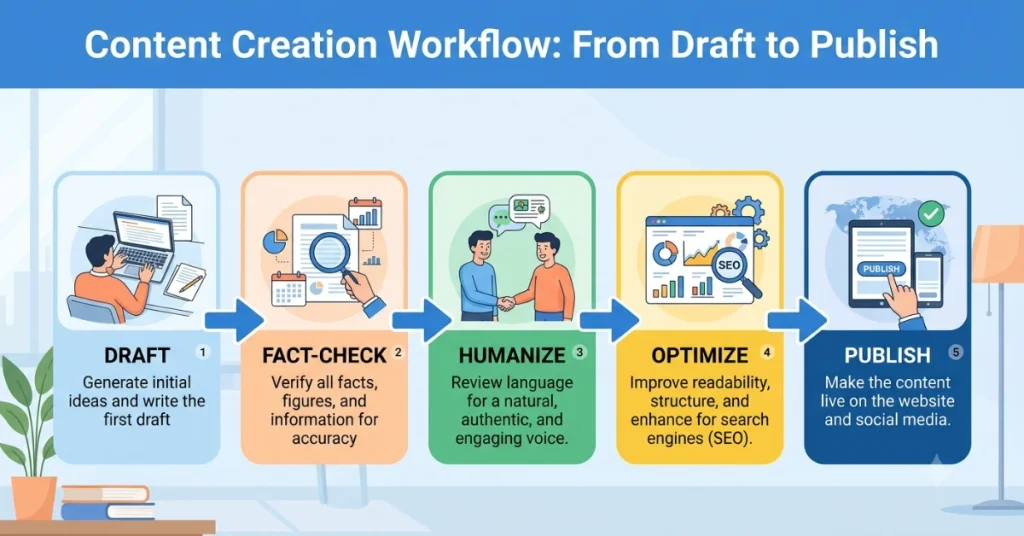
The 7-Step Process to Turn an AI Draft Into a Ranking Post
This is the workflow I’d follow today.
Step 1: Start With Search Intent, Not a Prompt
Before you open any tool, Google your target phrase. What do the top results look like? Guides? Lists? Comparisons? Your post should fit that shape.
Then pick one main keyword and a few supporting ones. For this topic, that might be AI content for SEO, AI-generated blog posts, and AI content workflow.
Step 2: Write a Better Prompt
A lazy prompt gets a lazy draft. Tell the AI who the reader is, what tone you want, what to include, and what to skip. Give it an outline. Feed it your notes.
Good AI content prompts read more like a brief to a freelancer than a Google search.
Step 3: Use AI for the Right Jobs
AI is great at:
- Brainstorming ideas
- Outlines
- First drafts
- Summaries and repurposing
- Meta descriptions and product descriptions
- Social captions and email variations
It’s not great at being the final word on anything. Which brings us to the next step.
Step 4: Fact-Check Everything
Models can sound very sure while being very wrong. This is called a hallucination, and it’s the fastest way to lose reader trust.
Check every statistic, quote, name, date, link, and product feature against a primary source. Check the title, meta description, and image alt text too. Google itself advises manual review of AI output.

Step 5: Add the Human Stuff
This is where rankings are won. Add:
- Your own experience. What did you try? What flopped?
- Original examples. Real numbers from your own site beat generic ones.
- Expert quotes. Ask someone who knows the subject.
- Your voice. Cut stiff phrases. Add a joke. Use contractions.
- Clear structure. Short paragraphs, honest headings, useful tables.
That’s also the answer to how to make AI-generated content sound human. You add the parts a machine can’t fake.
Explore related tips in our guide on Common AI Blogging Mistakes.
Step 6: Optimize Without Overdoing It
Work your main keyword into the title, intro, a heading or two, and the conclusion. Sprinkle secondary keywords where they fit. If you have to force it, skip it.
Tools like Surfer SEO, Frase, and Clearscope can show you which topics your draft is missing. Treat their scores as hints, not commandments.
Step 7: Publish, Track, and Improve
Hit publish, then watch Google Search Console. See which queries bring impressions. Update the post when you learn something new. A living post usually beats a forgotten one.
Should You Disclose That AI Helped?
Google suggests giving readers context when it isn’t obvious how content was made. A short note works fine, something like “Drafted with AI assistance and reviewed by our editor.” It’s honest, and honesty builds trust.
Can AI Detectors Tell If It’s AI?
Not reliably. AI content detectors produce both false positives and false negatives. Don’t use them as the only reason to reject a writer or a draft.
What does work is a quality check: does this read like a real person with real knowledge wrote it? If yes, you’re in good shape.
Is AI Content Plagiarism? Who Owns It?
Not automatically plagiarism. But a model can echo protected wording, and if you publish unverified material without credit, that’s on you. Run an originality check and cite your sources.
As for AI content copyright, ownership depends on the tool’s terms, your country’s laws, how much human authorship went in, and whether third-party material was used. Read the commercial-use terms before you publish or sell anything. If the stakes are high, ask a lawyer. I’m not one.
Check out our detailed article on Best Free AI Tools for Bloggers in 2026.
What Should You Never Fully Automate?
Medical, legal, financial, safety-critical, and news content. These are “your money or your life” topics, where mistakes hurt people. A qualified human must review them before they go live.
Tools That Can Help
You don’t need all twenty tools you’ll see online. Pick a small stack.
| Goal | Tools to consider |
|---|---|
| Ideas and drafting | ChatGPT, Gemini, Claude |
| Marketing copy | Jasper, Copy.ai, Writesonic |
| Editing and clarity | Grammarly, Wordtune |
| SEO optimization | Surfer SEO, Frase, Clearscope |
| Content operations | HubSpot Content Hub, Narrato |
| Short, affordable copy | Rytr, Anyword |
| Images | Canva AI, Midjourney |
| Video and audio repurposing | Descript, Pictory, Lumen5 |
A simple starter stack: ChatGPT or Gemini for the draft, Grammarly for polish, Surfer SEO or Frase for optimization, Google Search Console for results, and you for the facts and voice. Pricing and features change often, so check each tool’s site before you commit.
A Quick Pre-Publish Checklist
- Does it answer the search query fast?
- Is every fact verified?
- Is there at least one thing only you could add?
- Does it sound like a person?
- Is it better than what’s already ranking?
If you can’t say yes to all five, keep editing.
Final Thoughts
So, how do you turn AI-generated content into Google-ranking blog posts? You let AI do the heavy lifting on speed, then you do the heavy lifting on trust. Research the intent, fact-check hard, add your real experience, and optimize lightly.
AI is a fast assistant. It’s a terrible boss.
Your move: pick one old AI draft you haven’t published, run it through the seven steps above, and see what happens. Then come back and tell me how it went in the comments. I read every one.
Disclaimer:
This article is intended for informational and educational purposes only. SEO strategies, AI tools, and Google’s ranking algorithms may change over time. While the tips shared in this guide can help improve content quality and SEO practices, there is no guarantee of Google rankings, indexing, or organic traffic growth. Always review, fact-check, and edit AI-generated content before publishing to ensure accuracy, originality, and value for readers. Google rankings depend on multiple factors beyond AI content creation.