
An in-depth review of Marcio Barreto’s AI-Driven Finance Toolkit. Discover its key frameworks, who it genuinely benefits, how it compares to alternatives, and whether it delivers real transformation for CFOs and FP&A teams.
Finance functions are under more pressure than at any point in recent memory Today’s CFO is no longer just a financial executive. McKinsey & Company reports that nearly 70% of a CFO’s time is now spent driving strategic priorities like digital transformation, risk management, ESG reporting, and organizational decision-making. governance, ESG reporting, and organizational leadership rather than conventional finance tasks. Meanwhile, the tools and processes many finance teams rely on remain stubbornly rooted in spreadsheet-era thinking. Recognizing this disconnect, Marcio Barreto’s AI-Driven Finance offers a practical framework that helps organizations transform finance operations through AI, automation, and lean methodologies.
This review goes significantly beyond surface-level impressions. The review takes an in-depth look at the book’s main arguments, evaluates each framework it presents, identifies the finance professionals who are likely to gain the most value, compares it with competing titles, and offers an objective assessment of its strengths and limitations. offers an honest verdict on whether it delivers the transformation it promises.
Who Is Marcio Barreto? Understanding the Author’s Credibility
Before evaluating any business toolkit, understanding the author’s background is essential. Barreto’s credibility comes from blending practical industry experience with a solid academic foundation, making his insights both reliable and actionable.
Marcio Barreto is a senior finance executive and certified Lean practitioner with hands-on experience leading finance transformation initiatives across multiple industries. His hybrid background — spanning CFO-level responsibilities and continuous improvement methodology — positions him unusually well to address the intersection of artificial intelligence, process efficiency, and financial management. This dual expertise matters because it prevents the common failure modes of books in this space: technologists who understand AI but lack finance depth, or finance professionals who understand the domain pain points but lack practical implementation knowledge. Barreto’s
credentials suggest he has navigated actual transformation projects, not just theorized about them — a distinction that becomes apparent in the toolkit’s orientation toward practical frameworks over abstract concepts.
What Is the AI-Driven Finance Toolkit? Core Premise and Scope
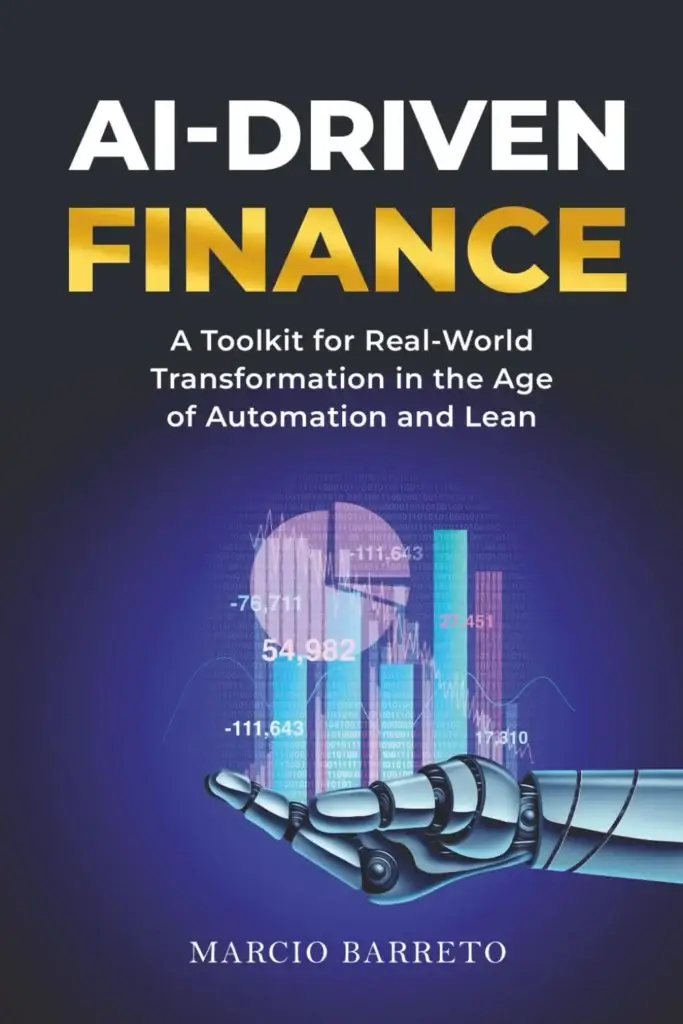
The book’s formal subtitle — A Toolkit for Real-World Transformation in the Age of Automation and Lean — establishes its intent clearly. This is not a theoretical text on artificial intelligence in finance, nor is it a general management book that mentions AI in passing. Instead, it presents a structured collection of frameworks, diagnostic tools, and implementation roadmaps specifically designed for finance teams ready to modernize their operations.
The core premise rests on a compelling observation: most finance functions remain reactive. They produce retrospective reports that tell leadership what happened last month rather than enabling real-time visibility or forward-looking prediction. Traditional monthly close cycles, manual reconciliations, and siloed data systems perpetuate this reactive posture — and they do so at significant cost in both time and strategic relevance.
According to Gartner research, finance functions that have successfully adopted AI-driven processes reduce time spent on transactional activities by up to 40%, redirecting that capacity toward analysis and strategic support. Barreto’s toolkit aims to guide finance teams through exactly this transition.
Chapter-by-Chapter Analysis: Breaking Down the Key Frameworks
The Reactive-to-Proactive Transformation Model
The foundational framework Barreto introduces is a phased transition model moving finance teams from reactive reporting through three distinct stages:
- Reactive Reporting: Teams primarily produce backward-looking reports; data is siloed; close cycles are manual and time-consuming
- Real-Time Intelligence: AI tools provide live dashboards and automated variance analysis; finance gains visibility as events unfold
- Predictive Partnership: Instead of simply documenting what has already happened, predictive analytics and AI empower finance teams to anticipate future trends and guide strategic business decisions.
This three-stage model provides a practical diagnostic tool. Finance leaders can immediately identify where their function sits on this spectrum and understand the specific capabilities required to advance to the next stage. The inclusion of diagnostic checklists for each stage is particularly valuable — they transform the abstract framework into a concrete self-assessment.
The Lean-AI Integration Framework
One of the most distinctive aspects of Barreto’s approach is his integration of Lean methodology with artificial intelligence implementation. Finding this combination is surprisingly difficult, even though it should be the standard. Many organizations pursue AI adoption without first eliminating the process waste that AI will inherit and potentially amplify.
Barreto’s framework draws on established Lean principles — value stream mapping, waste identification, continuous improvement cycles — and applies them specifically to finance workflows before AI tools are introduced. The sequencing is deliberate: streamline first, automate second.
This approach addresses a critical failure mode in finance AI projects. The Association for Financial Professionals (AFP) highlights that most AI failures in finance stem from automating inefficient workflows, resulting in faster execution but little improvement in the quality of financial outputs.
Are you In a Hurry?
Don’t have time to read the full review? If you’re looking for a practical guide to implementing AI in finance, AI-Driven Finance by Marcio Barreto is worth a closer look. Check the latest price, reader reviews, and availability on Amazon before making your decision.
AI Implementation Roadmap and Diagnostic Tools
One of the toolkit’s most valuable sections provides structured implementation plans customized for different types of organizations. Rather than presenting a single universal AI adoption path, Barreto acknowledges that a mid-size manufacturing company and a multinational financial services firm face substantially different transformation challenges and starting points.
The diagnostic checklists cover:
- Current-state capability assessment — evaluating existing technology infrastructure, data quality, and team skills
- Process mapping templates — identifying which finance workflows represent the highest AI automation potential
- Risk and readiness scoring — assessing organizational readiness for change including leadership commitment and change management capacity
- Implementation sequencing guides — prioritizing which automation initiatives to pursue first based on effort-to-impact analysis
These tools represent the practical differentiator between this toolkit and more conceptual treatments of finance AI. The checklists alone could provide significant value to a finance team conducting an honest self-assessment.
Predictive Risk Management Applications
The section on predictive risk management covers one of AI’s most high-value applications in the finance function. Traditional risk management in finance is largely backward-looking: identifying risks that have already materialized through variance analysis and after-the-fact reporting.
AI-enabled predictive risk management fundamentally changes this. By analyzing patterns across multiple data streams — financial history, market conditions, operational metrics, macroeconomic indicators — machine learning models can identify emerging risks weeks or months before they appear in financial statements.
Barreto covers specific applications including:
- Cost overrun prediction in project-based businesses
- Cash flow stress testing using scenario-based AI modeling
- Supplier and counterparty risk monitoring through continuous data analysis
- Revenue at-risk identification using customer behavior and market signals
Each application is supported by case study evidence demonstrating actual outcomes — a methodological choice that significantly strengthens the book’s credibility over toolkits relying purely on hypothetical examples.
Check out our detailed article on “ChatGPT Expertise PLR: The Complete 2026 Guide”.
Automation of Routine Finance Tasks
The automation framework covers the most accessible entry point for most finance teams: eliminating low-value manual work that consumes disproportionate time. Barreto identifies several high-priority automation candidates:
- Invoice processing and accounts payable automation — typically one of the highest-volume, most error-prone manual processes
- Bank reconciliation automation — particularly valuable for organizations managing multiple entities and accounts
- Variance analysis and commentary generation — AI-generated narrative explanations of financial variances that previously required manual interpretation
- Expense categorization and policy compliance checking — reducing the audit burden on finance teams while improving accuracy
According to Deloitte’s Global Finance Automation Report, organizations that automate routine finance tasks achieve average cost reductions of 15–40% in those specific process areas while simultaneously improving accuracy and reducing close cycle time. These figures provide important context for evaluating the ROI case Barreto builds.
Real-World Case Studies: Where Theory Meets Practice
A defining strength of the AI-Driven Finance Toolkit is its grounding in actual organizational experience. Barreto includes several detailed case studies that illustrate both the complexity and the achievable outcomes of finance AI transformation.
Case Study 1: Manufacturing Sector FP&A Transformation
One case study documents a mid-size manufacturing organization where the FP&A function operated a traditional monthly close cycle consuming 12 business days. Through a combination of Lean process redesign and AI-powered data integration tools, the organization reduced close cycle time to 4 days while simultaneously improving forecast accuracy from approximately 78% to 91%.
The case study honestly addresses the 18-month implementation timeline, the organizational resistance encountered, and the specific change management interventions that ultimately drove adoption — adding credibility to what could otherwise appear as an idealized success story.
Case Study 2: Service Industry Real-Time Dashboard Implementation
A second case study covers a professional services organization transitioning from static PowerPoint-based management reporting to live AI-generated dashboards. The finance team’s role shifted substantially — from spending 60% of time building reports to spending that same capacity on interpretation, scenario analysis, and strategic recommendations to business unit leaders.
The case study quantifies outcomes in terms both financial leaders and business executives can appreciate: faster decision-making, identified cost savings opportunities that static reporting had missed, and measurable improvement in finance’s perceived strategic value to the organization.
Comprehensive Pros and Cons Assessment
Strengths
Practical, Implementation-Ready Frameworks: Unlike many business books that treat implementation as someone else’s problem, Barreto provides tools that finance teams can immediately apply. The diagnostic checklists and roadmaps in particular offer genuine starting points rather than abstract direction.
Authentic Practitioner Perspective: The author’s dual background as a finance executive and Lean practitioner is evident throughout. The content avoids the common pitfall of treating AI as universally applicable magic while also avoiding excessive caution that would undermine the toolkit’s transformational ambition.
Case Study Credibility: The inclusion of honest case studies — including documentation of challenges, timelines, and organizational friction — significantly enhances the toolkit’s trustworthiness compared to resources presenting only idealized outcomes.
Lean-AI Integration: The deliberate sequencing of Lean process improvement before AI implementation is a sophisticated insight that many organizations miss. This framework alone could prevent costly AI adoption failures.Breadth of Application Areas: The toolkit covers predictive risk management, automation, real-time reporting, and strategic alignment in sufficient depth to be useful across multiple finance team roles and organizational contexts.
Limitations
Specialized Audience Requirement: The toolkit assumes baseline familiarity with finance operations. Professionals from adjacent functions who want to understand AI’s potential in finance may find the content dense without that foundational context.
Organizational Dependency: Many of the toolkit’s recommendations require meaningful organizational commitment — executive sponsorship, IT infrastructure investment, and cross-functional collaboration. Finance leaders in organizations where these conditions are absent face implementation barriers the book acknowledges but cannot resolve.
Technology Landscape Specificity: The AI tools landscape evolves rapidly. Some technology-specific recommendations may require updating as the software environment changes — a limitation inherent to any publication covering fast-moving technology domains.Variable Applicability by Organization Size: Certain frameworks are more readily applicable in mid-to-large enterprises with dedicated finance technology budgets. Smaller organizations may need to scale down recommendations significantly, and more guidance on right-sized approaches would strengthen the toolkit’s accessibility.
Read our complete guide on “Best Free AI Tools for Bloggers in 2026”.
Who Should Read the AI-Driven Finance Toolkit?
Ideal Readers
Chief Financial Officers and Finance Directors leading digital transformation initiatives will find the highest density of value. The strategic framing, case studies, and ROI analysis tools speak directly to their organizational mandate.
FP&A Managers and Senior Financial Analysts will benefit most from the automation frameworks and real-time reporting guidance. These roles typically carry the heaviest burden of manual reporting work and stand to gain most from AI adoption.
Finance Transformation Specialists and Consultants will find the Lean-AI integration framework particularly valuable, both as a client diagnostic tool and as a conceptual foundation for transformation project design.
Business Leaders Partnering with Finance — including COOs, strategy directors, and general managers — can use this toolkit to understand what to expect from a modernized finance function and how to create the organizational conditions for successful transformation.
Readers Who May Struggle
Professionals with limited finance operations background will likely need supplementary resources to fully leverage the toolkit’s content. Similarly, individual contributors in early career finance roles may find the organizational and strategic focus misaligned with their current scope of influence.
Comparison with Competing Resources in AI Finance
The AI-Driven Finance Toolkit does not exist in isolation. Several competing resources address adjacent topics:
| Resource | Primary Focus | Key Differentiator vs. Barreto’s Toolkit |
| The CFO Guidebook (Steven Bragg) | Traditional CFO role and processes | Lacks AI/automation coverage |
| Gartner Finance AI Research Reports | Market intelligence and vendor landscape | No implementation methodology; high cost |
| AFP Digital Finance Resources | Professional education | Broader scope, less implementation depth |
| Big 4 Finance Transformation Frameworks | Enterprise-scale transformation | Consulting-oriented; not self-service |
| Barreto’s AI-Driven Finance Toolkit | Lean-AI integration for finance teams | Unique combination of Lean + AI + practical tools |
The most significant competitive advantage of Barreto’s toolkit is precisely this combination: Lean methodology integrated with AI implementation frameworks, packaged as self-service diagnostic and planning tools. No comparable resource available to finance leaders in the current market occupies this specific niche as comprehensively.
Practical Implementation Advice: Getting Maximum Value from This Toolkit
Reading the AI-Driven Finance Toolkit is the beginning, not the end, of the transformation journey it describes. Finance leaders who derive maximum value from this resource typically follow several implementation principles:
Conduct the diagnostic assessments before reading further. The checklists in the early sections of the toolkit are most valuable when completed against your actual current state, without the confirmation bias that can develop after reading Barreto’s prescriptive recommendations.
Start with one high-impact process. Rather than attempting to implement all recommendations simultaneously, identify a single finance workflow where automation potential is high and organizational resistance is manageable. A visible early win builds the organizational support required for broader transformation.
Build a cross-functional coalition early. Finance AI transformation almost always requires IT partnership for data infrastructure, HR support for skills development, and executive sponsorship for organizational prioritization. Engaging these stakeholders before the implementation begins dramatically improves success probability.
Measure before and after. The toolkit’s frameworks are most compelling when supported by quantified outcomes. Baseline measurements of current process cycle times, accuracy rates, and time allocation enable genuine ROI calculation rather than post-hoc rationalization.
Revisit the diagnostic tools annually. The finance AI landscape evolves continuously, and organizations that use the diagnostic tools as an annual health check — rather than a one-time assessment — sustain transformation momentum over multi-year periods.
The Broader Context: Why AI Finance Transformation Matters Now
The urgency of finance AI adoption is not hypothetical. The global AI in financial services market was valued at approximately $38.36 billion in 2024 and is projected to grow at a compound annual growth rate of 16.5% through 2029, according to MarketsandMarkets research. Organizations that delay transformation while competitors accelerate adoption face a growing strategic disadvantage in both operational efficiency and analytical capability.
Furthermore, the skills expectations placed on finance professionals continue to evolve rapidly. The World Economic Forum’s Future of Jobs Report identifies data analysis, AI literacy, and strategic advisory skills as increasingly essential for finance roles — precisely the capabilities that AI-assisted finance processes build when adopted effectively. Resources like Barreto’s AI-Driven Finance Toolkit, therefore, address not just current operational inefficiency but future workforce and competitive positioning. Finance leaders who invest in developing AI-enabled capabilities now are building the institutional capacity their organizations will require across the next decade.
Don’t miss our comprehensive guide on Ottocast P3 Pro Review 2026: Android AI Box.
Final Verdict: Is the AI-Driven Finance Toolkit Worth Your Investment?
After a comprehensive assessment, AI-Driven Finance: A Toolkit for Real-World Transformation in the Age of Automation and Lean earns a strong recommendation with appropriate qualifications.
For the right reader — a finance leader with organizational scope to drive transformation, sufficient infrastructure to support AI adoption, and the time to apply the diagnostic tools thoughtfully — this toolkit delivers exceptional value. The combination of Lean methodology, AI implementation frameworks, honest case studies, and practical diagnostic tools creates a resource that is genuinely difficult to find elsewhere.
For organizations earlier in their transformation journey — those without executive sponsorship for digital transformation or significant gaps in data infrastructure — the toolkit provides an invaluable diagnostic and aspirational providing a realistic implementation roadmap, allowing organizations to make steady progress even when full-scale adoption is not yet possible.
Overall Assessment: 4.4 / 5
The toolkit succeeds in its core ambition: providing finance professionals with a practical, credible, implementation-ready guide to transforming their function through AI and Lean principles. Its depth, honest framing of challenges, and unique methodology combination position it as an essential resource for any finance leader committed to moving from reactive reporting to genuine strategic partnership.
View the AI-Driven Finance Toolkit on Amazon
Frequently Asked Questions
Is this book relevant for small business finance teams?
The toolkit is most comprehensively applicable to mid-size and large organizations. However, small business finance leaders can derive value from the diagnostic frameworks and automation priorities even if enterprise-scale AI implementations are not feasible in their context.
Do I need technical AI knowledge to use this toolkit?
No. Barreto explicitly targets finance professionals, not technologists. The frameworks assume finance domain knowledge rather than AI technical expertise. Collaboration with IT partners is recommended for implementation but is not required to understand and plan transformation initiatives.
How long does a typical finance AI transformation take?
The case studies in the toolkit document timelines ranging from 9 months for targeted automation initiatives to 24–36 months for comprehensive function transformation. Realistic planning should account for organizational readiness, technology procurement, and change management — not just technical implementation.
What AI tools does the book recommend?
Rather than endorsing specific vendors, Barreto provides evaluation criteria and capability categories, which allows the guidance to remain relevant as the technology market evolves. Specific tool selection is treated as a procurement decision informed by organizational requirements.
External Authoritative Sources Referenced
- McKinsey & Company — The CFO Agenda
- Gartner — Finance Transformation Research
- Association for Financial Professionals — Finance Automation
- Deloitte — Global Finance Automation Report
- MarketsandMarkets — AI in Financial Services Market
Affiliate Disclimer:
This article may contain affiliate links. If you purchase through these links, I may earn a small commission at no additional cost to you. I only recommend products that I believe provide genuine value based on my research and review. Your support helps keep this website running and allows me to continue creating free, high-quality content.